Vertical take-off & landing
What Is VTOL?
VTOL stands for Vertical Take-Off and Landing — a category of aircraft, including UAVs, that can launch and land without a runway, then transition to efficient forward flight once airborne.
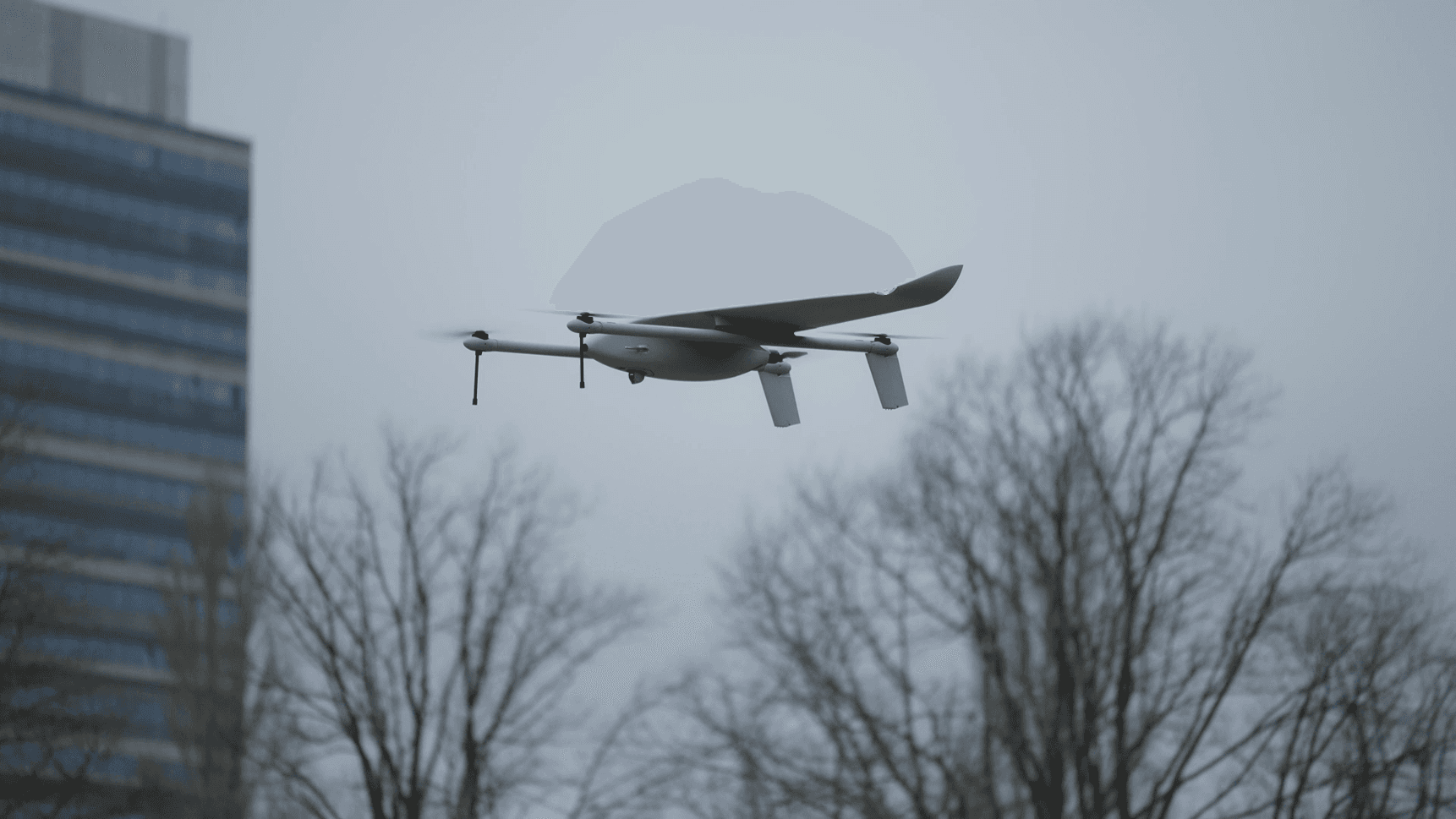
Unlike a traditional helicopter, which uses rotors for all phases of flight, a fixed-wing VTOL uses its rotors only for take-off and landing. Once in the air, it switches to a fixed wing, flying more like a plane. This gives it the best of both worlds: the flexibility of a helicopter with the range and efficiency of a fixed-wing aircraft.
Why does this matter for commercial drone operations?
For unmanned operations — port surveillance, infrastructure inspection, emergency response, logistics — VTOL removes the biggest practical constraint: the need for launch infrastructure. A VTOL UAV can take off from a rooftop, a quayside, or a field, fly tens of kilometres, and land precisely where it needs to be.
This flexibility is also what makes VTOL the ideal architecture for BVLOS (Beyond Visual Line of Sight) operations — long-range autonomous missions where the drone operates far outside the pilot's line of sight. Without fixed-wing efficiency, those flight distances simply aren't viable.
For a practical walkthrough, read our guide to adding fixed-wing drones to a police fleet.
Multirotor or fixed wing VTOL
Type of VTOL
Multirotor
Fixed-wing
Endurance
20–45 min
60–180 min
Cruise Speed
40–80 km/h
80–150 km/h
Hover Precision
Excellent
Moderate
Mechanical Complexity
Limited
Medium
BVLOS Suitability
None
Excellent
Typical Use Case
Inspection, delivery, imaging
Survey, BVLOS, long-range
How Avy builds fixed-wing VTOL for autonomous operations
Avy designs and operates fixed-wing VTOL aircraft built specifically for long-range autonomous missions — not as a concept, but in active deployment across Europe.
The Avy Aera is a fixed-wing VTOL hybrid. It takes off vertically using four lift rotors, transitions to fixed-wing cruise flight, and covers up to 100km at 100km/h on a single charge. During transition — the phase where most fixed-wing VTOL aircraft are at their most vulnerable — the Aera maintains full redundancy across its propulsion system. It operates in winds above 30 knots and in rain, meeting the operational envelope that emergency services and infrastructure operators actually require.
What makes VTOL viable at scale is not the aircraft alone. Avy pairs the Aera with a ground docking station that charges and launches the aircraft autonomously, and a remote operations centre from which missions are monitored without anyone on site. This combination — fixed-wing VTOL aircraft, autonomous dock, and remote operations — is what enables BVLOS missions to run continuously from a fixed deployment point with no ground crew.
Avy holds a BVLOS LUC (Light UAS Operator Certificate) in the Netherlands, one of the first operators in Europe to receive this authorisation for commercial fixed-wing VTOL operations.