Get started understanding BVLOS; what it means, why it matters, how the regulation works in Europe, and what it takes to actually fly it.
Let's get started
What is BVLOS?
BVLOS stands for beyond visual line of sight. It is the point at which drone operations stop being a short-range tool and start to become part of the infrastructure.
Within 500 metres, a drone can inspect a building, film a scene, or monitor a small area. Beyond it, the possibilities change entirely. A single aircraft can patrol 100+ kilometres of coastline in a single flight. It can reach a fire before the first engine leaves the station. It can deliver blood to a hospital that road transport cannot reliably serve. It can survey a pipeline crossing challenging terrain, inspect every pylon on a transmission network, or provide persistent surveillance across a port the size of a small city — all without a pilot standing in a field watching it go.
Fully enabled BVLOS starts to open up further innovations such as; multiple aircraft, operating autonomously from unmanned docking stations, managed by a single operator from a remote control centre. This covers geography that ground-based operations simply cannot and the economics change too: one operator, many missions, no ground crew at either end. It's something which has been understood in principle for a long time and expectations haven't matched the reality, but that's slowly changing.
This is why BVLOS matters to ports, energy companies, emergency services, defence organisations, and logistics networks. Not because drones are novel, but because BVLOS makes them useful at the scale those organisations actually operate at.
Getting there, however, requires clearing a regulatory hurdle. BVLOS operations break the fundamental assumption that underlies standard drone rules; that a pilot can see their aircraft at all times. In most European countries this limits usable range to approximately 500 metres. Beyond that distance, a drone becomes too small to track reliably with the naked eye (there are more exact ways of measuring VLOS depending on the aircraft) and the pilot loses the ability to assess its orientation, detect other airspace users, or respond to hazards in real time.
BVLOS operations substitute direct visual observation with onboard sensors, automated systems, command-and-control (C2) data links, and real-time telemetry. The pilot operates remotely, sometimes from a fixed operations centre many kilometres from the aircraft and relies on the aircraft's systems and operational infrastructure rather than their own eyes to manage the flight safely.
The practical difference between VLOS and BVLOS is not just range. It is the entire model of how drone operations are conceived, staffed, and authorised.
Example BVLOS operation:
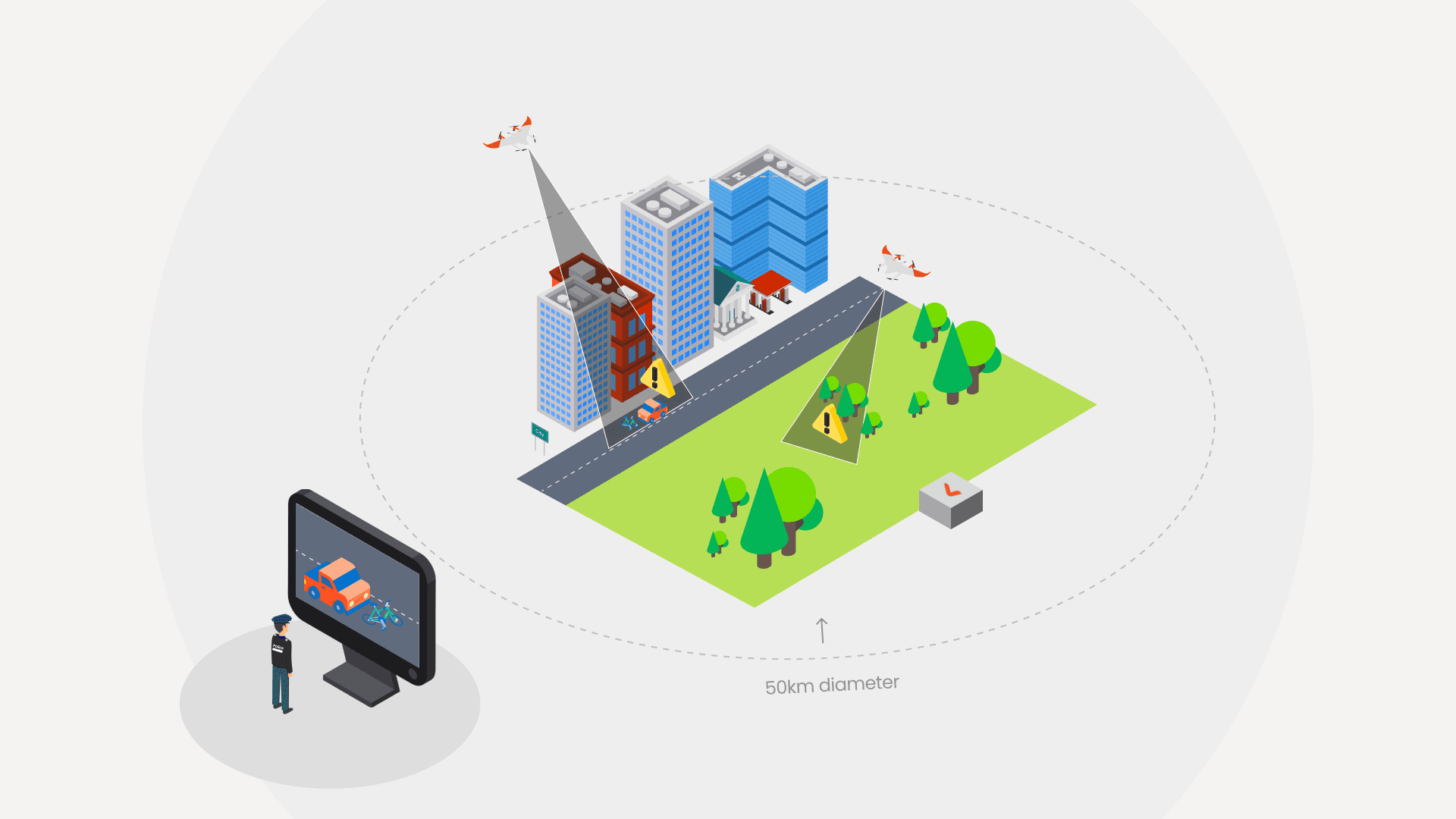
For a practical walkthrough, read our guide to adding fixed-wing drones to a police fleet.
Where we've been
The 500-metre visual limit exists for safety reasons. A pilot who can see their aircraft can react to unexpected hazards — a bird, another drone, a change in weather — in ways that an automated system cannot yet fully replicate. For low-risk operations in controlled environments, VLOS is a practical and proportionate constraint.
For industrial applications, it is not.
Consider what VLOS means in practice for a large infrastructure operator. Inspecting a 100-kilometre pipeline under VLOS rules requires a pilot stationed every 500 metres along the route; 200 pilots, 200 ground vehicles, and 200 sets of equipment to cover a single asset in a single pass. At a port covering 50 square kilometres, a VLOS operation can surveil a fraction of the site before it reaches its operational boundary. For emergency services, a drone-as-first-responder programme covering a county rather than a single street is impossible under VLOS rules.
VLOS also enforces a 1:1 relationship between pilots and aircraft. One pilot manages one drone within visible range. BVLOS breaks this constraint. A single operator working from a remote control centre can manage missions across multiple sites, with aircraft flying autonomously along pre-planned routes and transmitting data in real time. This is the operational model that makes drone networks economically viable at scale.
The rules
Drone operations in the European Union are governed primarily by two EASA regulations: EU 2019/947 (operational rules) and EU 2019/945 (product requirements). These divide all drone operations into three categories based on risk.
Open category covers low-risk operations: VLOS only, below 120 metres, limited aircraft weight. No authorisation from the national aviation authority (NAA) is required. A consumer drone flown in a park is an Open category operation.
Specific category covers medium-risk operations; everything beyond the Open category limits. This includes BVLOS, aircraft over 25kg, operations in urban environments, flights above 120 metres, and operations over populated areas. Specific category operations require either a risk assessment submitted to the NAA, a pre-defined risk assessment (PDRA), or in the most advanced case, a Light UAS Operator Certificate (LUC). The approval mechanism varies by the nature and complexity of the operation.
Certified category covers high-risk operations equivalent to manned aviation: transporting people, carrying dangerous goods, or operating aircraft where the risk cannot be adequately mitigated under the Specific category framework. This requires airworthiness certification of the aircraft and operator certification equivalent to traditional aviation licences.
BVLOS operations sit firmly in the Specific category. This is significant because it means every BVLOS operation requires a demonstrated safety case — not just a licence or a registration, but a substantive analysis of the risks of a specific operation, the mitigations applied, and evidence that those mitigations are robust enough to meet the required safety threshold.
Risk assessment
SORA stands for Specific Operations Risk Assessment. It is the structured methodology used to assess and approve BVLOS and other complex drone operations under the Specific category framework.
A SORA analyses a proposed operation from two directions: ground risk (what happens if the aircraft comes down uncontrolled) and air risk (what happens if the aircraft encounters other airspace users). Each dimension is scored based on factors including the characteristics of the aircraft, the nature of the area overflown, the altitude and airspace class, and the technical and procedural mitigations the operator has in place.
The output of a SORA is a SAIL level, a score from I to VI that defines the specific operational safety objectives (OSOs) the operator must meet before the flight can be authorised. Higher SAIL levels demand more sophisticated safety systems, more rigorous procedures, and more extensive evidence of organisational competence. A SAIL VI operation, at the extreme end of the Specific category, approaches the complexity of certified manned aviation.
The SORA process is not a one-time exercise. Each distinct operation type, a new route, a new environment, a new aircraft configuration typically requires its own SORA. For operators without advanced regulatory status, this means submitting each SORA to the NAA for review and approval, a process that in the Netherlands and most EU member states takes months.
Safety
The SAIL scale runs from I to VI. The Open category covers operations below SAIL I. Most commercially meaningful BVLOS operations — flying over sparsely populated areas, operating in uncontrolled or controlled airspace — sit at SAIL II or above.
SAIL II is the level at which Avy currently self-authorises its operations. This covers BVLOS flights over sparsely populated areas, in controlled or uncontrolled airspace, including civil control zones (CTRs). It is the level that allows Avy to operate at the Port of Rotterdam, conduct patrol missions for emergency services, inspect power and rail infrastructure, and deliver cargo in authorised corridors.
Reaching SAIL II requires the operator to demonstrate a fully functioning safety management system (SMS), documented procedures for every phase of flight, trained and competent personnel, maintenance systems, incident reporting processes, and the organisational maturity to manage the entire safety envelope without external oversight on each individual flight.
The SAIL level also determines what happens when things go wrong. For example at SAIL II, safety systems, procedures, and trained operators are the primary safeguard, not the presence of a pilot watching the aircraft from the ground.
Certification that matters
The Light UAS Operator Certificate is the highest level of regulatory authorisation available to drone operators under the EU Specific category framework. An LUC holder can self-authorise its own SORA-based operations without submitting each assessment to the NAA for individual approval. The operator becomes, within defined limits, its own competent authority.
This distinction matters enormously in practice. For an operator without an LUC, every new BVLOS operation in a new location requires an application to the NAA, a review process, and a formal authorisation decision. In most EU countries this takes between three and six months per application. For an LUC holder, the same process can be completed internally in a matter of days.
Obtaining an LUC is not straightforward. The national aviation authority audits the applying organisation against a comprehensive set of requirements covering safety management systems, operational procedures, personnel training and competence, maintenance and airworthiness control, compliance monitoring, and the overall organisational infrastructure needed to manage complex drone operations safely without case-by-case regulatory supervision. Most organisations that apply are not ready on the first attempt. The requirements reflect the responsibility being transferred: an LUC holder is trusted to make safety-critical decisions that would otherwise rest with the regulator.
LUC holders form a very small group in Europe. The certificate is not a commercial product that can be purchased or obtained through a training course. It is a regulatory judgement that an organisation has demonstrated the maturity, systems, and competence to operate autonomously at the highest levels of the Specific category.
Making it happen
Avy began its application for a BVLOS LUC on December 30, 2020 — the day before the new EASA drone regulations entered into force in the Netherlands. The first submission was rejected. The Dutch Civil Aviation Authority (ILT) made clear how far the organisation was from the maturity level required. What followed was three years of iterative improvement: resubmissions, audits, feedback from senior ILT inspectors, and continuous development of the safety management systems, procedures, and organisational infrastructure that an LUC demands.
At the end of 2023, Avy was granted its LUC — the first BVLOS LUC issued in the Netherlands.
Must Read
Avy is one of the first BVLOS LUC holders in the Netherlands
Being granted an LUC signifies that Avy is compliant with specific standards and regulations approved by the European Commission with EASA as delegate agency - the regulations 2019/947 and 2019/945.

Dominik Kondziela
Marketing & Communications Lead
Regulation
The LUC authorises Avy to self-approve SORA-based operations at SAIL II. This covers VLOS, EVLOS, and BVLOS operations in controlled and uncontrolled airspace, over controlled ground areas and sparsely populated areas, including within civil control zones. Avy currently holds six approved SORAs covering a range of operational scenarios:
Remote operations (generic)
BVLOS above sparsely populated areas in reserved airspace (generic)
BVLOS above sparsely populated areas in segregated airspace (Veluwe)
BVLOS above sparsely populated areas in civil CTR airspace
Limited BVLOS within the Port of Rotterdam
Functional testing operations
For organisations that want to deploy long-range autonomous drone capability, Avy's LUC has a direct practical implication. Rather than waiting months for regulatory approval of a new operation, Avy can assess, self-authorise, and begin flying new routes in days. The regulatory overhead that makes BVLOS prohibitively slow for most operators is already resolved.
Avy has conducted authorised BVLOS operations for the Port of Rotterdam, ProRail, Koninklijke Marine, Politie, and Brandweer in the Netherlands, as well as programmes in Belgium, Botswana, Benin, and beyond. The Dutch Ministry of Infrastructure and Water Management has featured the Avy Aera in its official policy documentation on the future of BVLOS operations in the Netherlands.
BVLOS capability is not a feature of Avy's product. It is the foundation on which every Avy operation is built.
Did we miss anything?
Here are a few of the frequently asked questions